Authoring + LMS
For years, digital training worked like an assembly line with two factories. You created the course in one tool. Then you exported it, uploaded it into another tool — the LMS — and crossed your fingers.
A typo? Back to the first tool, fix it, export again, upload again.
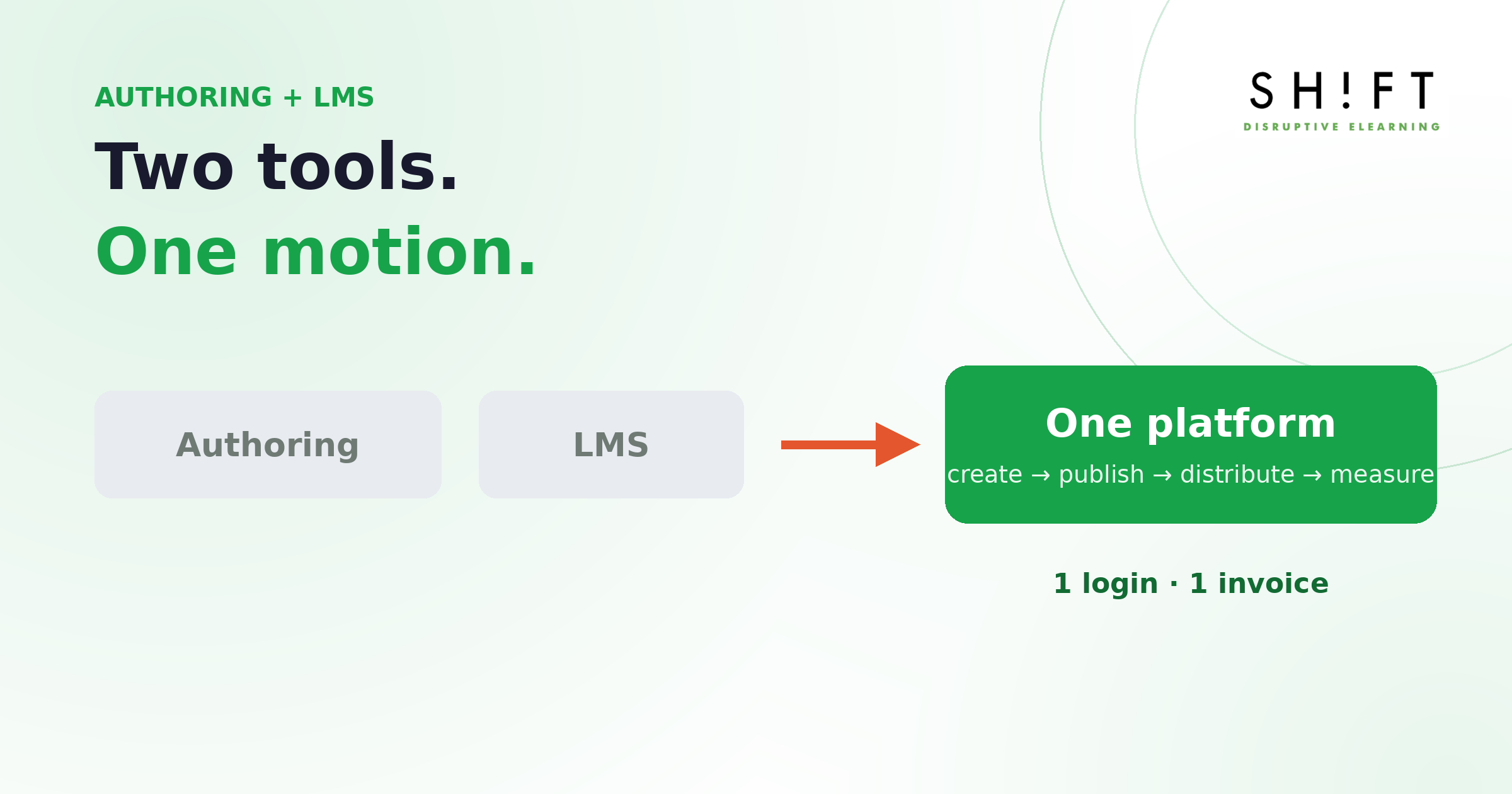
That era is ending. Creating and delivering training are no longer two tools: it's one motion.
The two-tools tax
You've probably lived it without naming it. Two platforms means two logins, two vendors, two invoices, and two support teams.
And something worse: a border in the middle of your process. Every time content crosses that border — export, download, upload, test — time is lost, duplicate versions appear, and nobody is sure which file is final.
We call that drag the two-tools tax. You pay it in hours, in errors, and in courses that take weeks to update.
The border disappears: what you create is already where your learners learn.
What changes when it's all one motion
Publishing stops being a project. You finish the course and it's already on the platform where your people live. No exporting, no uploading, no testing whether it opened correctly.
Fixing takes minutes. Spotted an error on Tuesday morning? You fix it in the same place, and by Tuesday afternoon everyone sees the good version. One version — always the current one.
Data tells you what to improve — and you improve it right there. When analytics shows a topic is confusing people, you don't open another tool: you edit the lesson in the same platform that showed you the data. The create-measure-improve loop closes in one place.
And your AI assistant works end to end. The same assistant that helps you create the course also enrolls the groups, sends the reminders, and generates the reports. One conversation, the whole cycle.
The idea in one sentence: when creating and delivering live in the same place, training moves at the speed of your business — not at the speed of your exports.
Are you paying the two-tools tax?
Clear signs that you are:
- Fixing a small error means exporting and re-uploading the whole course.
- Three versions of the same course exist, and nobody knows which is final.
- Your team spends hours testing that the upload "actually works" in the LMS.
- Updates pile up because publishing costs too much effort.
- You pay two invoices — and sit through two renewals — for one single process.
Five tips for making the move
The future has no borders
What's happening to training is what already happened to photos, documents, and music: separate tools merged into continuous experiences. Nobody misses the cables or the attachments.
Creating and delivering learning have merged too. The teams that adopt it first will publish faster, fix faster, and learn faster from their own data. That's the whole game.
And this is only half the story. A unified platform solves creating and delivering. But what about the images, the audio, the video, the avatars — everything that makes a course feel professional?
This Thursday we publish part two: the full AI studio for content and media creation. If you liked this, Thursday gets better.
Create and deliver, in one place
SHIFT's LMS lives in the same ecosystem where you create your courses with AI: create, publish, distribute, and measure without leaving the platform. Creating eLearning since 1996, with 6+ million people trained across 43+ countries.
Meet the platformReady to transform your corporate training?
See real results from companies that train with SHIFT — or talk to our team.