The SHIFT Blog

Upskilling With AI: Small Skills That Compound Into Big Careers

September 3, 2026 ·Diana Cohen
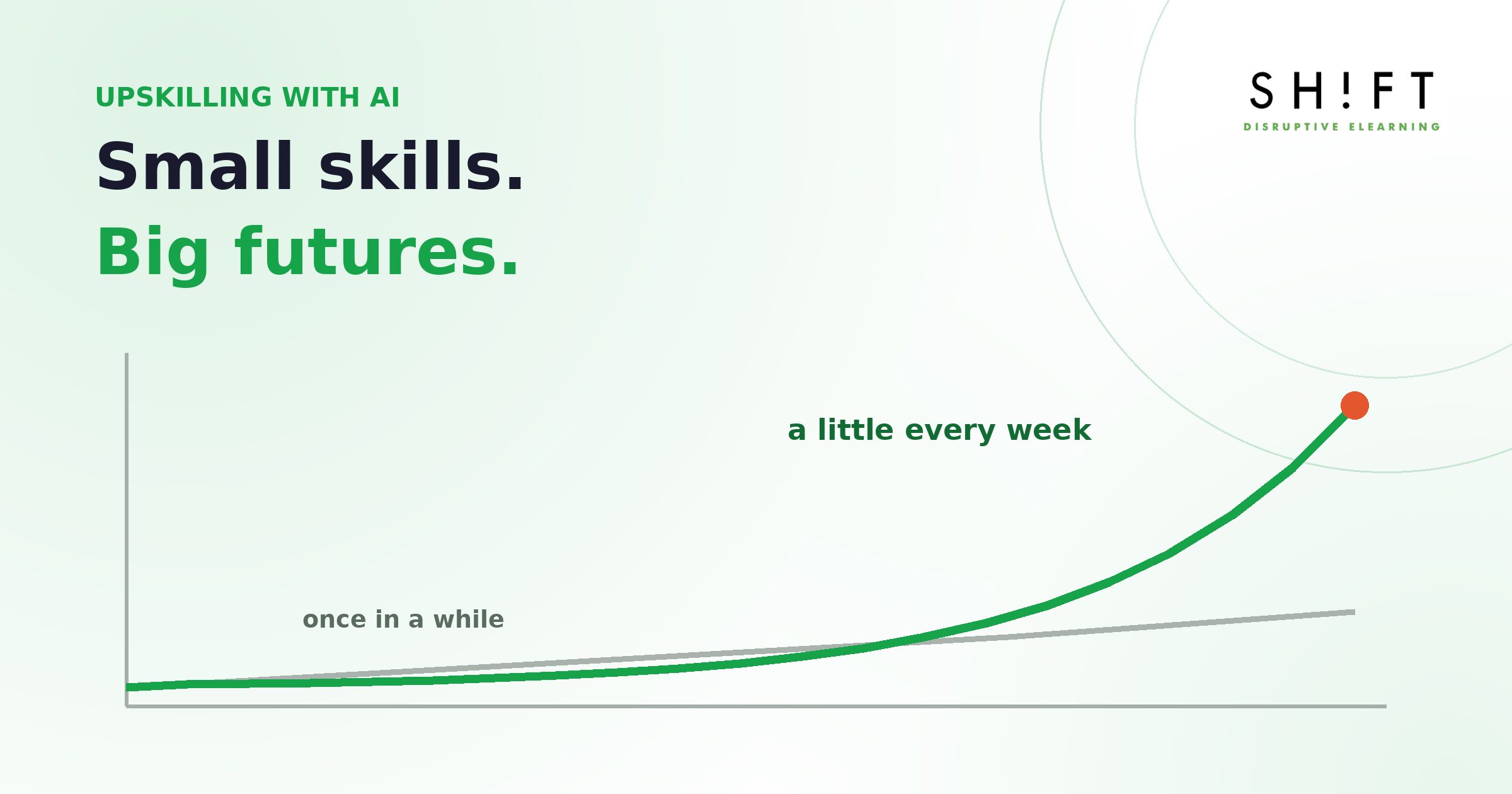
Chart: learning a little every week compounds into much bigger growth than occasional efforts

Upskilling with AI

Your career grows the way savings grow: not through one lucky strike, but through small, constant deposits that multiply over time.

Finance people call it compound interest. Learning works exactly the same way: every new skill is worth more because it combines with the ones you already have.

And here's the great news of this era: AI just raised the interest rate on learning.

Skills don't add up — they multiply

Think in examples. A salesperson who learns to read data isn't "sales + data." She's a salesperson who knows which customers to call first. Worth far more than the sum.

A supervisor who learns to give feedback didn't gain one skill. He multiplied the performance of his whole team.

Someone who learns to work with AI assistants didn't learn a tool. They accelerated every other skill they already had.

Every new skill combines with everything you already know. That's why the person who learns a little every week ends up, a few years later, in a completely different place.
time growth learning once in a while a little every week, compounded

Conceptual diagram: small consistency beats giant, occasional efforts.

Why AI changed the math

Compound interest always existed. What changed is the cost of each "deposit."

Learning a skill used to be expensive: courses far away, impossible schedules, limited seats. A lot of ambition stayed on the to-do list.

Today you have new allies. An AI assistant can create the exact course you need. It can answer your questions in the moment of work — not weeks later. It can let you practice without fear. And a dashboard shows your progress, so motivation doesn't depend on memory.

The result: learning costs less, arrives faster, and gets applied the same day. When cost drops and frequency rises, compounding takes off. Investing in yourself has never been this affordable.

How to pick high-leverage skills

Not all skills compound equally. These five rules help you choose the multipliers:

1. Pick skills that combine with what you already know. The most valuable skill isn't the newest one on the market — it's the one that makes your current experience more powerful. Ask yourself: which skill would make what I already do well even more valuable?
2. Prefer skills you'll use every week. A skill you use often reinforces itself — every use is a free review. One you don't use evaporates. Frequent use IS the compound interest.
3. Learn just in time, not just in case. What you learn for a real challenge this week stays with you. What you learn "in case it's useful someday" is usually forgotten before that day comes.
4. Practice in your real work from day one. Don't wait to "finish the course" before applying. Apply today what you learned today. Real work is the best laboratory — and now you have an assistant to consult along the way.
5. Make your progress visible. What gets seen gets sustained. Keep a simple record of what you've learned and applied. Watching the curve rise is the best fuel to keep going.

What your skill stack looks like

Your current experience + this quarter's skill + the next one + the next one New opportunities

Every new block rests on the ones before it. The full stack is your advantage.

Three example stacks

To make it concrete, imagine three possible paths:

The salesperson who becomes an advisor. She knows how to sell. She adds data literacy: now she knows who to call first. She adds storytelling with numbers: now her proposals convince directors. Three blocks; a completely new role.
The service agent who becomes a leader. He has mastered customer care. He adds difficult conversations: now he resolves the cases others escalate. He adds giving feedback: now he trains the new hires. His stack made him the natural candidate to coordinate the team.
The analyst who becomes the voice of the business. She knows how to analyze. She adds simple communication: now her findings are understood. She adds executive presentations: now her analysis moves decisions. The knowledge was always there; the new blocks made it visible.

Common mistakes (easy to avoid)

Collecting courses without applying them. The certificate is not the goal; the change in your work is. One course applied is worth more than five stored away.
Starting five skills at once. It divides your energy and nothing compounds. One per quarter: it shows, it sticks, and it motivates you to continue.
Waiting for the perfect moment. Compound interest rewards time, not perfection. Starting small today beats starting perfectly "in January."
Learning in secret. Tell your leader what you're building. Projects will appear where you can apply it — and allies who will recognize it.

A simple plan to start this week

  • 1Pick ONE skill for this quarter. Use the five rules above. Just one. Focus compounds too.
  • 2Block a short, fixed time every week. Small but non-negotiable. Consistency beats the marathon.
  • 3Apply it in a real project. Decide from the start where you'll use it. Learning with a concrete destination multiplies retention.
  • 4Review your progress monthly and choose the next block. Celebrate what you learned, adjust course, and keep stacking.

Three frequent questions

"What if I don't have time?" You don't need big study blocks. The key is learning in the flow of work: asking your assistant at the moment of doubt, practicing inside your real tasks. That way the workday itself becomes learning.
"Where do I start if I don't know what to pick?" Ask two questions. To yourself: which skill would make what I already do well more valuable? To your leader: which skill would you love to see in me? Where the answers overlap — that's your first block.
"Is this only for technical roles?" Not at all. The skills that compound the most are usually human ones: communicating, negotiating, giving feedback, teaching. And AI just made them practicable like never before — with simulations, examples, and unlimited repetitions.

If you lead a team

Everything above multiplies when the leader makes it easy. Make each person's progress visible. Celebrate new blocks the way you celebrate results. And connect every skill to a real project where it can shine.

A team where each person compounds their own growth doesn't need to be pushed. It pushes itself.

The future belongs to those who learn

Here's the brightest part: you no longer need permission to grow.

The engine that used to be a privilege of the few — tailored courses, an always-available tutor, unlimited practice, measurable progress — is now within reach of anyone with the desire. AI doesn't replace your effort: it multiplies it.

And when each person grows, the team grows. When the team grows, the organization becomes unstoppable. Everyone wins. That's what abundance looks like, applied to talent.

Start compounding your growth

The SHIFT ecosystem supports the whole cycle: create courses with AI, learn in the flow of work, practice with simulations, and measure progress. Creating eLearning since 1996, with 6+ million people trained across 43+ countries.

Discover SHIFT's solutions
Share: in 𝕏 f

Ready to transform your corporate training?

See real results from companies that train with SHIFT — or talk to our team.