"Ninety-five percent completion." It sounds like success. It might mean nothing.
Completion tells you people reached the last screen. It doesn't tell you whether they learned anything, liked it, or do their job differently now. Those are different questions — and they need different numbers.
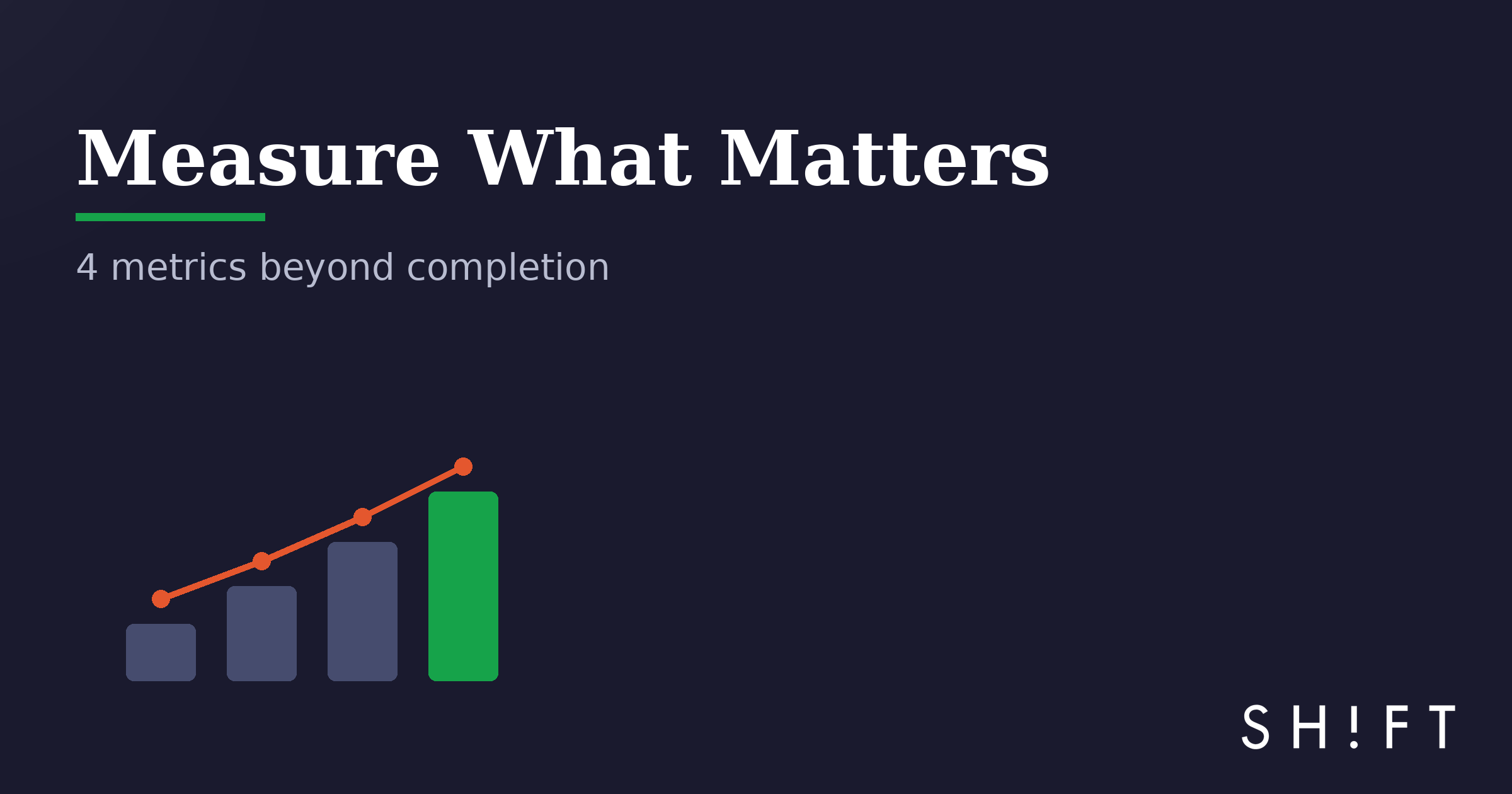
We covered the basics in our earlier article on eLearning success metrics. Here is the simple, updated way to think about it: four families of metrics, from easiest to most valuable.
1. Engagement: are they showing up?
How often people log in, how long they stay, whether they finish on time. Engagement is your early warning system: when it drops, something is wrong — the content, the timing, or the relevance.
One question to ask: do people come back without being chased?
2. Knowledge: did anything stick?
Compare what people knew before the course with what they know after. A short quiz before, the same quiz after. No difference between the two scores means the course transferred nothing — no matter how polished it looked.
One question to ask: can they do or explain something now that they couldn't before?
3. Satisfaction: would they recommend it?
Satisfaction alone doesn't prove learning — people can enjoy a useless course. But low satisfaction predicts trouble: skipped modules, rushed quizzes, bad word of mouth. Ask two things: was it useful for your job, and would you recommend it to a colleague.
One question to ask: are the comments about the content, or about the experience? (You'll fix them differently.)
4. Impact: did work actually change?
This is the family executives care about. Pick the job number the training was supposed to move — errors, sales conversations, response times, audit findings — and look at it before and after. Not every course needs this level. Your expensive, strategic ones do.
One question to ask: if this program disappeared tomorrow, what number would get worse?
How healthy is your measurement? A 60-second check
Tap what's true for your current program. Be honest — nobody's watching.
Tap the statements that are true for you.
Make it easy on yourself
None of this works if the numbers live in five different places and someone has to build a spreadsheet every quarter. The teams that measure well are the ones whose platform collects engagement, scores, and feedback automatically — and shows them on one screen.
That's exactly what SHIFT's performance dashboards do, working hand in hand with SHIFT LMS. See your training the way your CFO sees the business. Ask for a walkthrough.
Ready to transform your corporate training?
See real results from companies that train with SHIFT — or talk to our team.