
Most companies that urgently need employee training have no training department. There is an HR generalist who owns "learning" alongside recruiting, payroll and culture; there are subject-matter experts with day jobs; and there is a growing list of things people must be trained on — compliance, safety, products, service, new systems. The conventional advice is to build a Learning & Development team first. This article argues the opposite: you can run training at the standard of the largest corporations without hiring a single specialist — if you understand what enterprise-grade training actually requires, and buy it as one packaged capability instead of assembling it piece by piece. Below you'll find the full anatomy of that capability, an interactive checker to map it against what you already have in-house, and a hard look at why implementation in Latin America deserves its own chapter.
What "enterprise-grade" actually means
Strip away the vendor language and corporate training is a chain with five links. Large organizations run all five; programs fail when one link is missing, no matter how strong the others are.
- 1. Professional content creation. Turning what your experts know into courses people actually finish: instructional design, writing, visual and audio production, interactivity. This is a craft, not a formatting exercise — the difference between a slide deck uploaded to a portal and a course that changes behavior is exactly this link. Modern AI-assisted production has made it dramatically faster, but faster production of the wrong thing is still the wrong thing; the design discipline is what makes speed useful.
- 2. A corporate learning platform. A system that enrolls the right people in the right courses, tracks every attempt and completion, issues certificates, and gives each audience its own catalog. Spreadsheet-and-email delivery collapses somewhere around the second course and the fiftieth learner — usually right when an auditor asks for evidence.
- 3. Realistic practice. Knowing and doing are different skills. Simulations — guided scenarios where a salesperson rehearses a difficult negotiation or a supervisor practices a hard conversation, safely and repeatedly — are how large organizations close that gap. This is the link mid-size companies most often skip entirely, because building practice environments in-house is beyond almost any small team.
- 4. Performance measurement. Dashboards that answer the questions leadership will actually ask: who completed what, where are people struggling, is the training moving the numbers it was meant to move. Without this link you can spend well and never be able to prove it.
- 5. Implementation and support. Someone has to launch the platform, load the audiences, run the campaigns, answer learners' questions and keep content current. This is the invisible link — and the one that quietly consumes the most hours.
Notice what this list implies: "training" is not one job. It is a small operation with several distinct specialties. That is the real reason companies without an L&D team feel stuck — not a lack of budget, but a lack of structure.
The hidden org chart behind a "simple" training program
Here is the uncomfortable arithmetic. Each link in the chain demands skills that rarely live in one person: instructional designers, multimedia producers, platform administrators, data analysts, project managers, learner-support staff. Hire for all of it and you have built a department; hire for part of it and the chain still has missing links.
And capability behaves like a fixed cost — the same concept that drives training ROI. A capability must be paid for whether you produce two courses a year or twenty. Large enterprises spread that fixed cost across hundreds of courses and thousands of learners, which is why they can afford specialists. A 300-person company producing six courses a year cannot — every specialist would be underused, yet every gap breaks the chain. That is the structural trap: below a certain scale, building the capability in-house is the expensive way to get a worse result.
The packaged alternative inverts the logic. Instead of hiring the org chart, you plug into one that already exists at full scale — a partner whose designers, producers, platform team and analysts are spread across many clients, so you pay for the fraction you use, as one predictable operating expense instead of a set of salaries. One provider, one login, one bill, covering the entire lifecycle: create, publish, distribute, measure.
Map your own gap
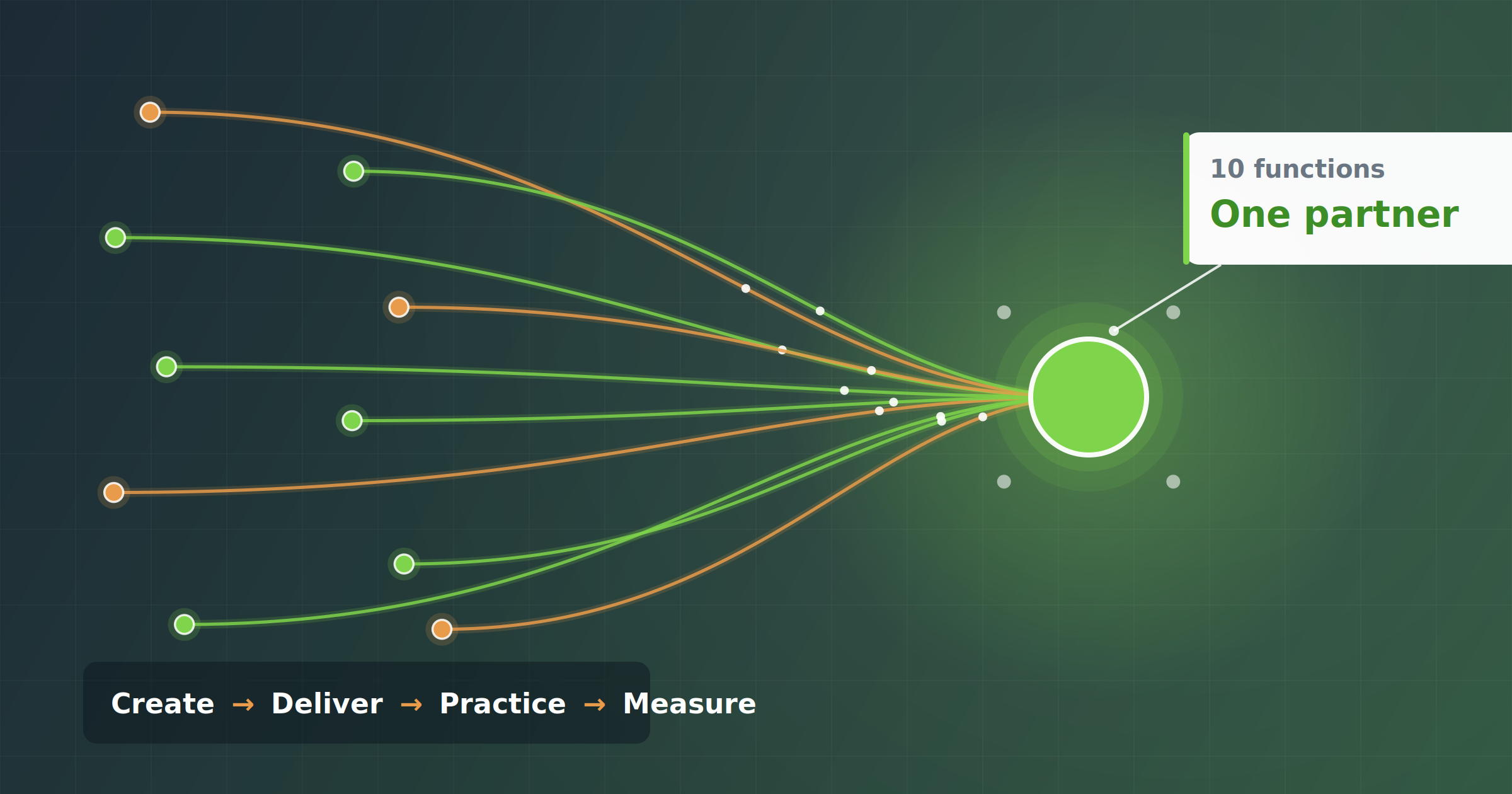
The checker below lists the ten working functions behind an enterprise-grade program, grouped by link in the chain. Switch on the ones your organization already covers with real, available capacity — not "someone could probably do it," but someone who has the skills and the hours. The gap that remains is what you would otherwise need to hire, train or improvise — and what a full-service partner absorbs on day one.
Create — turning expertise into courses people finish
Deliver — the right course to the right person, with proof
Practice — where knowing becomes doing
Measure — the answers leadership will ask for
Run — the invisible work that keeps the program alive
Your coverage map
This checker maps functions, not headcount — in small organizations one person may stretch across two functions, and in large ones each function is a team. It states no costs and assumes no vendor: it simply makes visible the structure any enterprise-grade program needs, wherever each piece lives.
Why one partner beats a patchwork — even before you talk price
Companies that decide against building a department usually try the middle path first: a tool here, a freelancer there, a platform subscription somewhere else. It feels cheaper. In practice it recreates the org-chart problem in a different form — now someone internal must integrate the tools, manage the vendors, chase the freelancers and reconcile the invoices. The coordination work you were trying to avoid comes back as your job.
The packaged model removes that coordination layer, and the benefits are structural rather than promotional:
- One accountability. When creation, delivery, practice and measurement come from one provider, there is no gap between vendors where problems go to die. One partner owns the outcome end to end.
- Predictability. A packaged service converts an unpredictable mix of salaries, tools and project fees into a planned operating expense — the format finance teams can actually approve and renew.
- Speed. The capability already exists at full scale; nothing has to be recruited or assembled. The distance from decision to first live course is measured in weeks, not hiring cycles.
- Compounding data. When the same ecosystem creates the course, delivers it and measures it, the analytics connect: you can trace a struggling team back to a specific lesson and fix it. Stitched-together tools rarely close that loop.
- You keep what matters. Your subject-matter experts stay the source of truth; the partner supplies the machinery around them. The knowledge remains yours — it just finally gets the production quality it deserves.
One caution belongs in this conversation, the same way it belongs in every ROI discussion: a partner cannot decide what your people need to learn. Priorities, business context and expert knowledge stay in-house by definition. What you are buying is everything after that decision.
The Latin America factor: implementation is a discipline, not a translation
Everything above applies anywhere. But if your teams are in Latin America, one more filter matters: most global training providers serve the region from far away, in a second language, on someone else's schedule. Implementation — the fifth link — is precisely the one that suffers most from distance.
Serving Latin America well means Spanish-first design rather than translated afterthoughts; localization that adapts examples, tone and regulatory context for each country instead of swapping words; support teams in your learners' language and your time zones; and rollout experience across markets whose labor and compliance rules differ meaningfully from one border to the next. These are learned capabilities, built over many implementations — not features that can be toggled on.
This is the ground we know best. We have been creating eLearning since 1996 — among the first to bring it to the region — and that operating base has grown into a global one: more than 6 million people trained across 43+ countries, for corporations, governments, universities and NGOs, with the work recognized by close to twenty international industry awards. For a company in the region without an internal L&D team, that combination — enterprise-grade machinery, implemented locally — is exactly the package the market historically didn't offer.
Questions to ask any training partner
Whoever you evaluate — us included — the checker above doubles as a due-diligence list. Ask each candidate: Which of the ten functions do you cover as one integrated service, and which will I still have to staff or coordinate myself? Can you show live dashboards, not sample screenshots, of how you measure performance? Can my teams practice — not just read — through simulations? Who implements, in which language, and in which time zone? What happens to my content and my data if we part ways? And can you name organizations of my size, in my region, that you serve today?
A partner with a complete package answers all six without handing you off to "an integration partner." A patchwork can't.
Start with a conversation, not a hire
If the checker showed you a gap of six, eight or ten functions, the takeaway is not that you are behind — it is that hiring your way out was never the right move at your scale. The capability exists, packaged, priced as a predictable service, and implemented in your language. Bring one real training need to a live session and we'll show you exactly how it would run across the full chain — created, delivered, practiced and measured, under one roof. Request your demo, or see how the pieces fit together on our solutions overview.
Ready to transform your corporate training?
See real results from companies that train with SHIFT — or talk to our team.