Instructional design models have been around for decades. Some people say AI made them obsolete. The opposite is true: when courses can be built faster than ever, a clear model is what keeps them from becoming noise.
Back in 2018 we published a quick guide to four instructional design models. It is still one of our most-read articles. This is the updated, simpler version — plus a short interactive picker to help you choose.
First, what is an instructional design model?
It is a recipe for making training that works. It tells you what to figure out first, what to build next, and how to check that people actually learned. You don't need to master all of them. You need one that fits your project.
ADDIE: the classic project plan
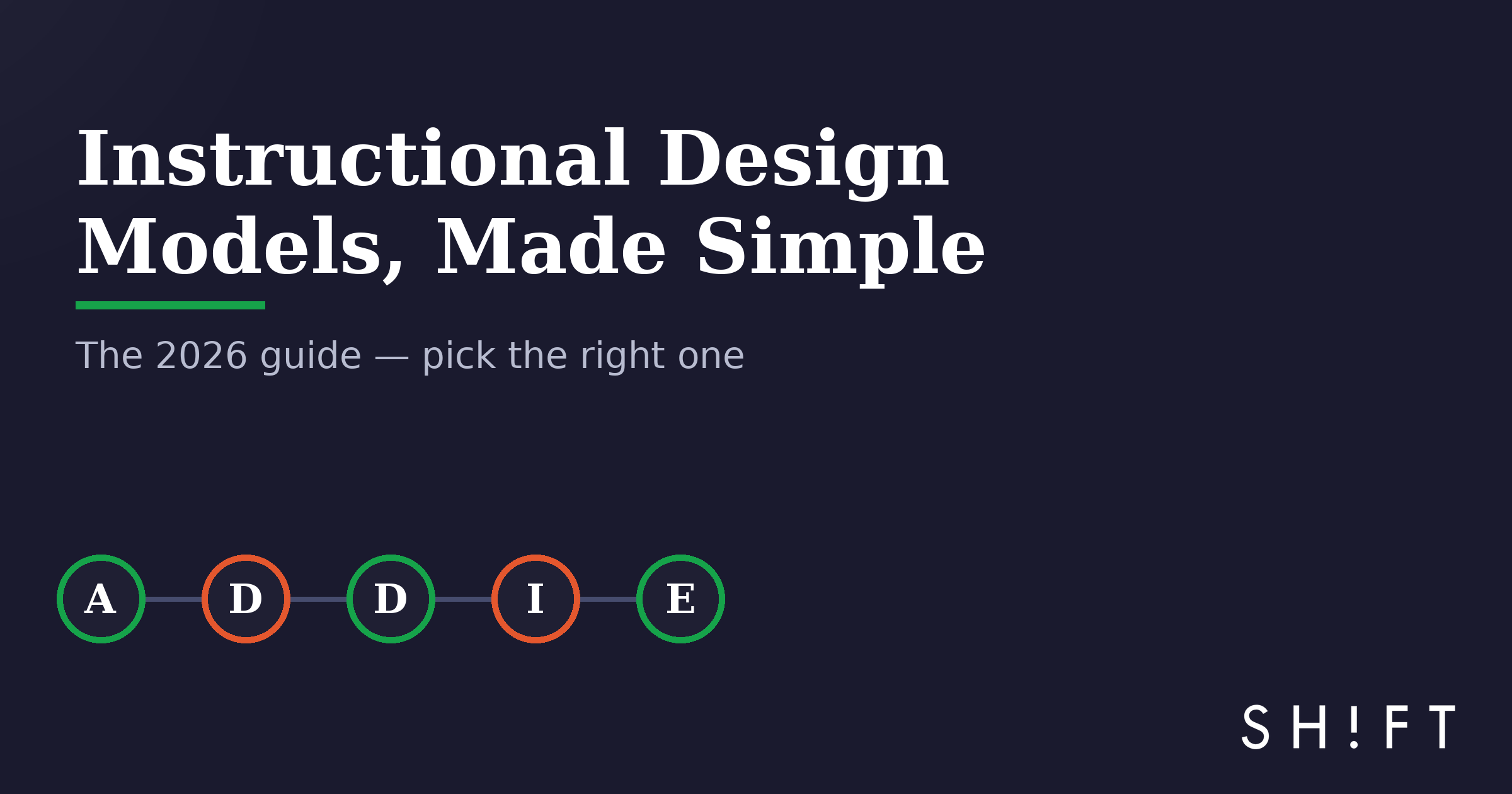
ADDIE stands for Analyze, Design, Develop, Implement, Evaluate. You move through five phases, one after the other.
Best for: big, high-stakes programs where mistakes are expensive — compliance, safety, certifications.
Watch out: it can feel slow. If your content changes every month, pure ADDIE will frustrate you.
Rapid prototyping: build small, learn fast
Instead of planning everything up front, you build a small working version early, show it to real learners, and improve it in rounds.
Best for: new topics, tight deadlines, and teams that want feedback before committing.
Watch out: without a clear goal, "iterating" becomes endless tinkering. Decide what success looks like before round one.
Merrill's principles: learning by doing real tasks
Merrill's idea is simple: people learn best when training is built around real problems from their job — not around topics. Show the task, let them practice it, help them apply it.
Best for: skills people must perform: selling, troubleshooting, serving customers.
Watch out: it takes effort to find real tasks. Talk to people who do the job, not just their managers.
Gagné's nine events: a checklist for each lesson
Gagné mapped the steps a good lesson walks through: get attention, state the goal, connect to what learners know, present the content, guide practice, give feedback, and check learning. Nine small steps in total.
Best for: structuring a single lesson or module so nothing important gets skipped.
Watch out: follow it too rigidly and every lesson feels identical. Use it as a checklist, not a script.
Bloom's taxonomy: words that make goals measurable
Bloom's taxonomy ranks thinking from simple to complex: remember, understand, apply, analyze, evaluate, create. Its superpower is verbs. "Know the policy" is impossible to measure. "Apply the policy to three real cases" is not.
Best for: writing learning objectives that mean something.
Watch out: don't force every course to reach "create." Sometimes "apply" is exactly enough.
Which one is right for you?
Answer three quick questions and get a suggestion. No wrong answers — this is a starting point, not a verdict.
1. What are you building?
2. How often will the content change?
3. What worries you most?
One last thing
Models tell you what good training looks like. They don't make the building faster. That part has changed: today an AI design assistant can turn your objectives, content, and chosen structure into a working course draft in a fraction of the time — while you stay in charge of the thinking.
That's exactly what Meteora, SHIFT's AI design assistant, was built for. Bring the model. It brings the speed. See it in action.
Ready to transform your corporate training?
See real results from companies that train with SHIFT — or talk to our team.