 Your Best Knowledge Shouldn't Train Someone Else's Model">
Every organization is quietly sitting on a body of knowledge it spent years and serious money to build: the way it onboards people, the methods that make its training work, the hard-won answers to questions customers actually ask, the playbooks that separate it from competitors. For most companies, that knowledge lives scattered across documents, courses, recorded sessions, and the heads of a few experienced people.
The arrival of capable AI assistants made an obvious promise: point a model at all that material and let anyone ask it anything. It's a good promise. The problem is how most teams reach for it. They paste their most valuable material into a general-purpose assistant they don't control, hosted somewhere they can't see, governed by terms they didn't write. That convenience has a cost that doesn't show up until later.
This isn't an argument that every company needs its own model. Plenty of everyday tasks are served perfectly well by general tools. The argument is narrower and, we think, harder to dispute: the moment your competitive edge lives inside your own content and know-how, the model that learns from it should be yours — private, segregated, and under your control.
What "private" actually buys you
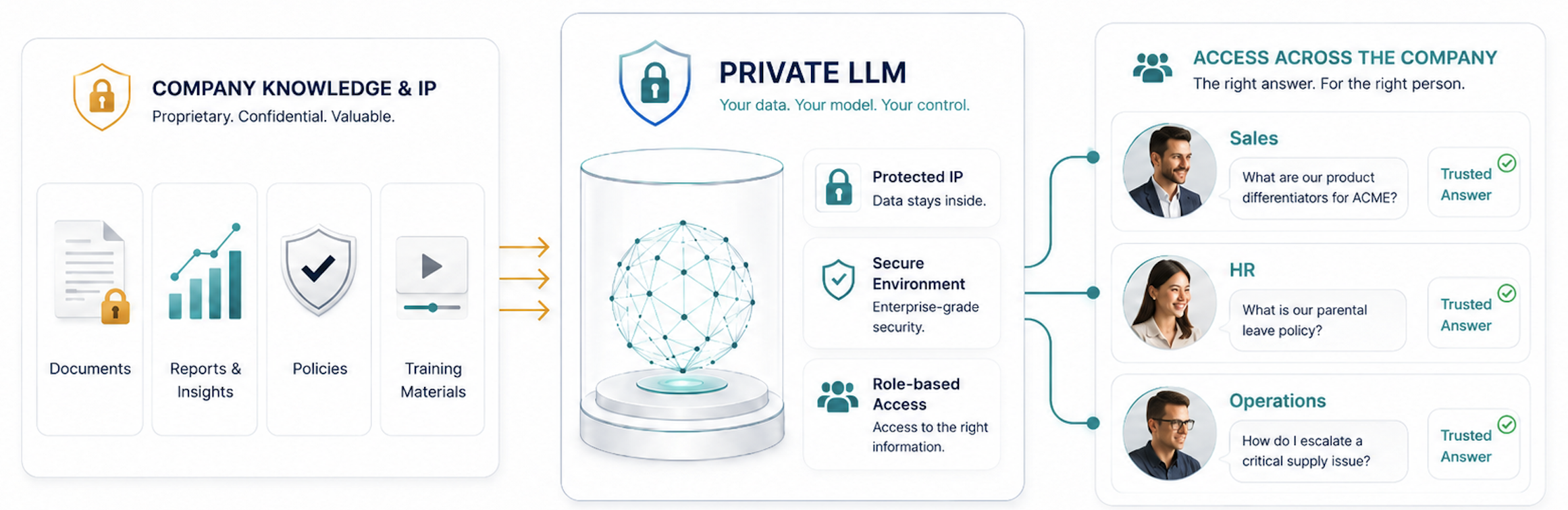
Your intellectual property stays your intellectual property. When proprietary material is fed into a system you don't govern, you lose the ability to answer basic questions with certainty: where does this data physically live, who can access it, is it retained, and could it influence a system used by people outside your company? A private model running on infrastructure you control collapses that uncertainty. Your content is used to serve your people and no one else's. For a knowledge base that took years to build, that distinction is the whole game.
Segregation is a feature, not a constraint. Keeping your corpus isolated isn't only about defense. A model grounded only in your verified material answers in your language, reflects your methods, and doesn't blur your specific guidance with generic advice pulled from the open internet. The boundary that protects you also sharpens the output.
Answers are anchored to sources you trust. The widely discussed weakness of general AI is its tendency to produce fluent, confident, wrong answers. The most reliable defense is to constrain the system to a curated, verified body of knowledge and have it cite where each answer came from. That's far easier to enforce when the knowledge base is yours, closed, and maintained deliberately — rather than the entire public web.
Control means longevity. Tools, vendors, and pricing change constantly. An approach built around owning your knowledge layer — your content, your model, your infrastructure — means the asset you're investing in is one you keep, regardless of which underlying technologies rise or fall. You're building equity, not renting a feature.
Why this matters specifically for learning and knowledge management
Learning and knowledge management are where the stakes concentrate, for a simple reason: the material is the value. A training program encodes how your organization does its best work. A knowledge base encodes the answers your customers and employees need most. These aren't generic documents — they're the distilled output of your experience.
Three things follow.
First, a private model turns a static library into something people can actually ask. A learner stuck at 9 p.m. doesn't need to file a ticket and wait; they ask, get an answer grounded in your approved material, and keep moving. The knowledge you already produced finally gets used at the moment of need.
Second, it protects the integrity of what people learn. When answers are drawn only from your verified content, you control accuracy. You decide what's authoritative. You're not hoping a general assistant happened to absorb your standards correctly — you're guaranteeing it can only draw from them.
Third, it compounds. Every course, document, and answer you add makes the system more useful, and all of that accumulating value stays inside a boundary you own. Over time the model becomes a genuine institutional asset: a living, queryable version of everything your organization knows, that no one outside can see, copy, or learn from.
The honest counterpoint
A private model is not free, and it isn't the right move for every workload. If your needs are limited to generic drafting and summarizing of non-sensitive material, general tools are likely enough. The case for going private gets strong precisely when the knowledge involved is proprietary, when accuracy and control are non-negotiable, or when the same material has to serve learning, support, and operations at scale. If that describes your situation, the question isn't really whether to keep that knowledge private — it's how soon you start.
Let's talk about your knowledge — privately
We built SHIFT LLM for exactly this: a private model, running on private cloud, trained on your organization's own intellectual property and kept segregated and secure. Your knowledge stays yours, your answers stay grounded in material you trust, and the asset you build keeps compounding inside a boundary you control.
If you're weighing what AI should do with your most valuable content — your training, your knowledge base, your hard-won institutional know-how — that's a conversation worth having before the material ends up somewhere you can't pull it back from.
When you want everyone in your organization to harness the full power of AI — without compromising your security, your intellectual property, or anything else you've worked to protect — a private model is how you give people that capability and keep the boundaries intact at the same time.
Talk to us about SHIFT LLM. Tell us what your organization knows, and we'll show you what a private model trained on it could do — securely, and on your terms.
Ready to transform your corporate training?
See real results from companies that train with SHIFT — or talk to our team.