
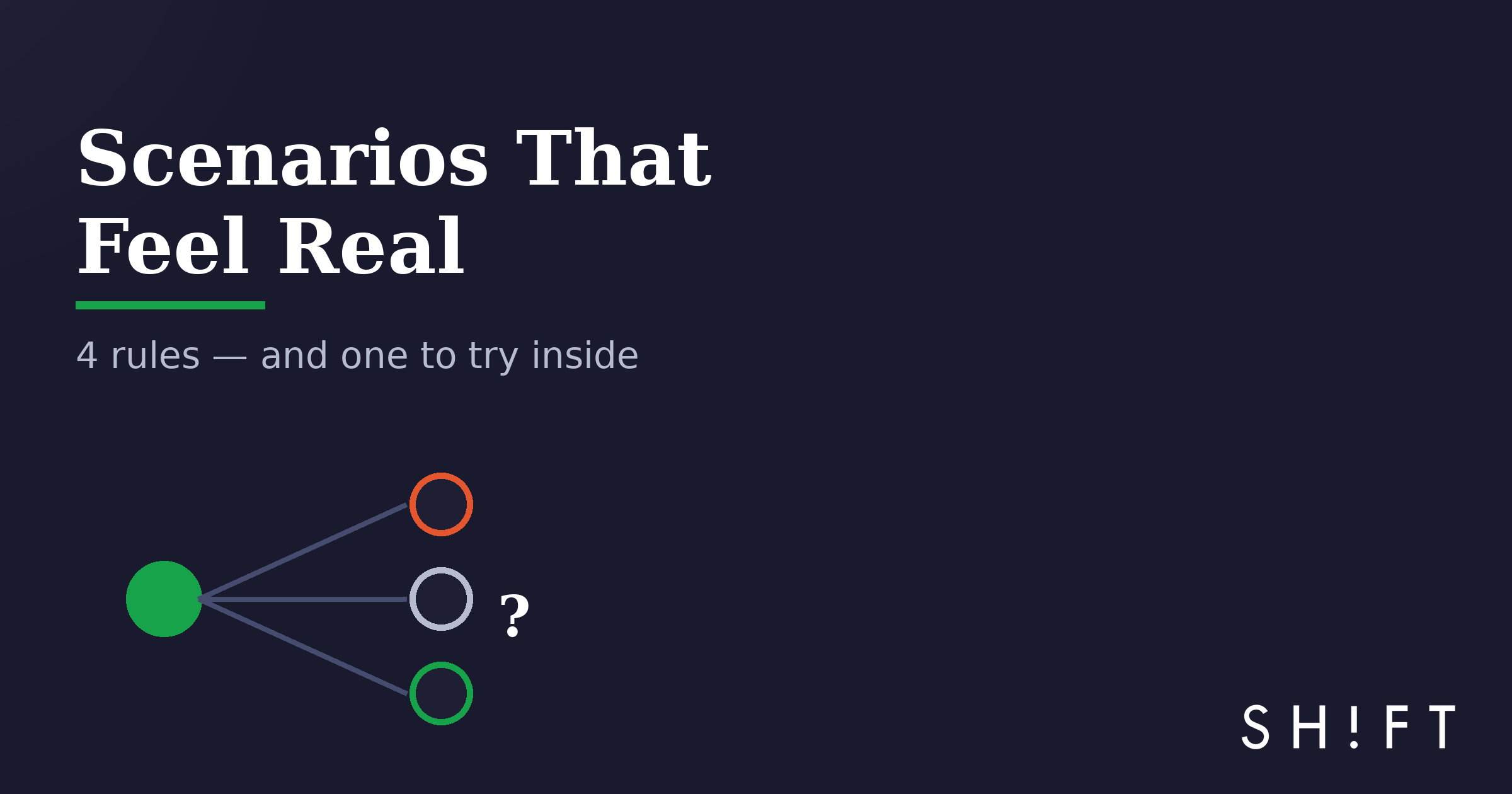
People forget bullet points. They remember the time they had to decide.
That is why scenarios work: instead of telling learners what to do, you put them inside a situation and let them choose. Done well, a scenario turns dry content into something people feel — and what people feel, they keep.
Here are four rules that separate scenarios that teach from scenarios that bore. (Yes — the rules from our classic Spanish article still hold. This is the updated take.)
Rule 1: Start from a real decision, not a topic
Weak scenarios start with content: "let's make a story about our returns policy." Strong scenarios start with a moment: "a customer wants a refund we can't give — what do you say first?"
Find the moments where people actually hesitate, get it wrong, or feel pressure. That hesitation is your script.
Rule 2: Make the character someone they recognize
Learners should look at the character and think: that's me on a Tuesday. Same role, same pressures, same imperfect information. When the character is a cartoon of perfection — or a stranger from another department — the learner watches. When it's them, they play.
Rule 3: Let choices have consequences, not lectures
The worst thing after a wrong choice is a paragraph explaining why it was wrong. The best thing is seeing what happens: the customer gets angrier, the deadline slips, the teammate goes quiet. Consequences create the small sting that makes the lesson stick. Explain later — briefly.
Rule 4: Keep it short and keep it moving
Two or three decision points beat ten. Trim every screen that doesn't contain a choice or a consequence. If a scenario takes longer than a coffee, it has stopped being an experience and become a course again.
Try one right now
Thirty seconds, one situation, three ways to answer. Notice how different each outcome feels.
Where this gets powerful
A written scenario like the one above is a great start. The next level is letting people actually speak: role-playing the conversation with a realistic virtual character that responds, pushes back, and gives feedback — privately, as many times as they need.
That's what SHIFT's Social Simulations were built for: safe practice for the conversations that matter most. See a demo.
Ready to transform your corporate training?
See real results from companies that train with SHIFT — or talk to our team.