
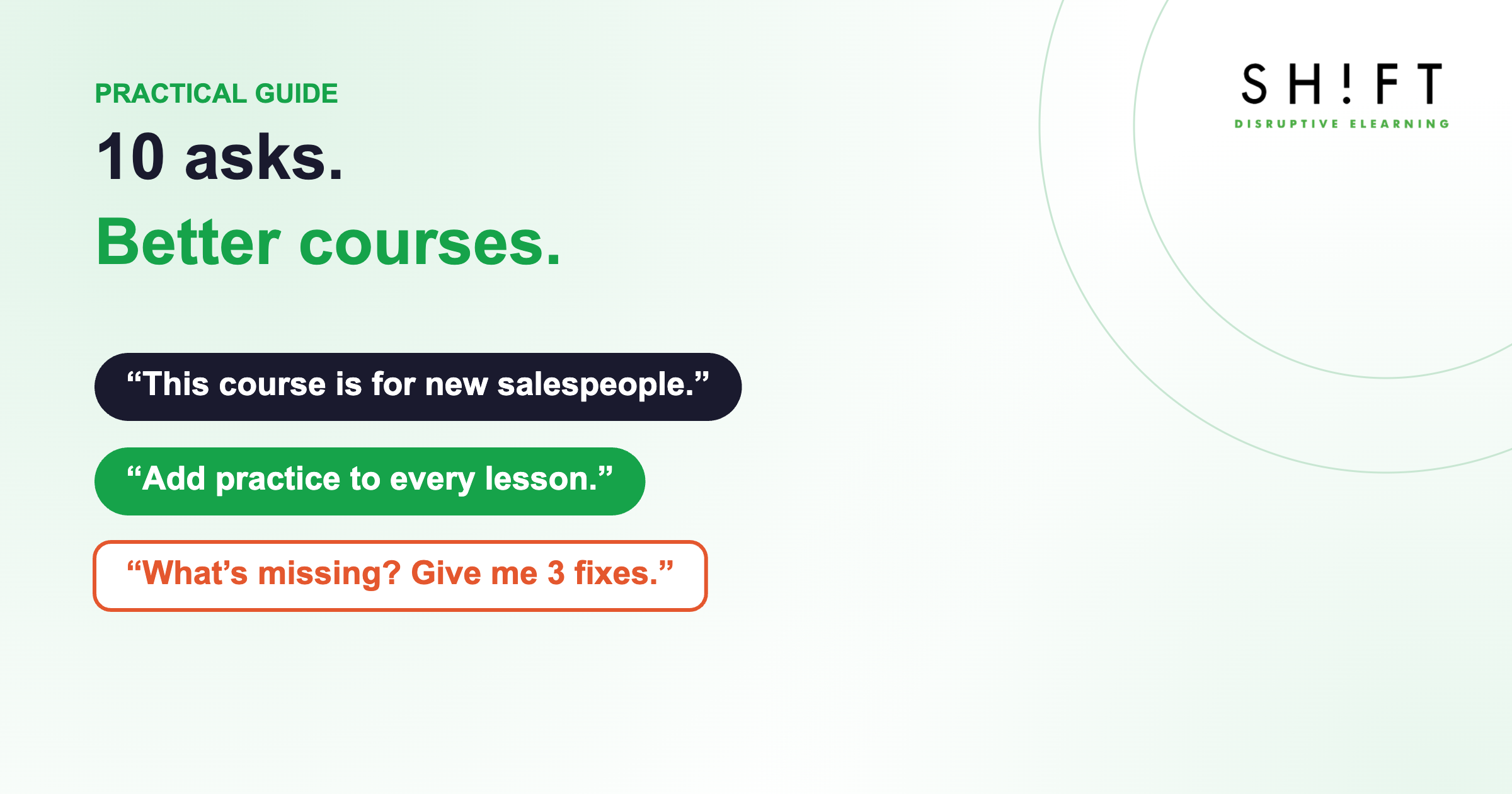
Practical guide
Your AI assistant can create very good courses. But there's a secret: the quality of what you get depends on what you ask for.
A vague request produces a generic course. A clear request produces a course that feels custom-made — because it is.
Here are 10 instructions that work. Copy them, adapt them to your topic, and use them today.
The golden rule: ask clearly, receive clearly.
The 10 instructions
Why it works: the assistant writes differently for a manager than for a technician. Tell it who will take the course and what their day looks like. Everything else improves.
Why it works: a goal is an action, not a topic. "Learn about sales" says nothing. "Be able to do X" gives the assistant a clear target — and gives you a way to know if the course worked.
Why it works: easy-to-read courses get finished more often. Ask for it upfront and the assistant keeps that style through the whole course.
Why it works: people learn between meetings and tasks. Short lessons fit real life. Long ones get abandoned halfway.
Why it works: people learn by doing. The assistant is very good at inventing realistic situations — but only if you ask.
Why it works: one example from the learner's world is worth three generic ones. The person sees themselves in the scene, and the content becomes theirs.
Why it works: "What would you do if the customer says X?" measures skill. "What does X mean?" measures memory. You want skill.
Why it works: what we learn fades without review. A five-minute recap, a few weeks later, protects your investment. Asking costs one sentence.
Why it works: your company already has knowledge written down. Give it to the assistant, and the course comes out with your reality inside — not internet generalities.
Why it works: the assistant can also critique. Asking for improvements at the end is the cheapest review in the world — and it almost always finds something good.
How to use this list
You don't need all ten at once. Start like this:
Today: take a course you want to create and use instructions 1, 2 and 3. Those three alone completely change the result.
This week: add practice (5) and industry examples (6). The course goes from "correct" to "good."
Always: close with number 10. Asking for improvements takes ten seconds and raises the quality every time.
One final tip: save your best asks. When an instruction gives you a great result, copy it into a team document. In a month you'll have your own recipe book — and anyone on the team will create courses at the same level.
Try them with a real assistant
Meteora is SHIFT's AI assistant for course creation: describe what you need and it builds with you. Creating eLearning since 1996, with 6+ million people trained across 43+ countries.
Meet MeteoraReady to transform your corporate training?
See real results from companies that train with SHIFT — or talk to our team.