
Practical guide
The first 30 days decide almost everything. A person who is welcomed well learns fast, feels part of the team, and stays. A person who feels lost... starts looking elsewhere.
The good news: great onboarding is not luck. It's a simple plan, week by week.
Here is that plan. Use it as-is, or adjust it to your company.
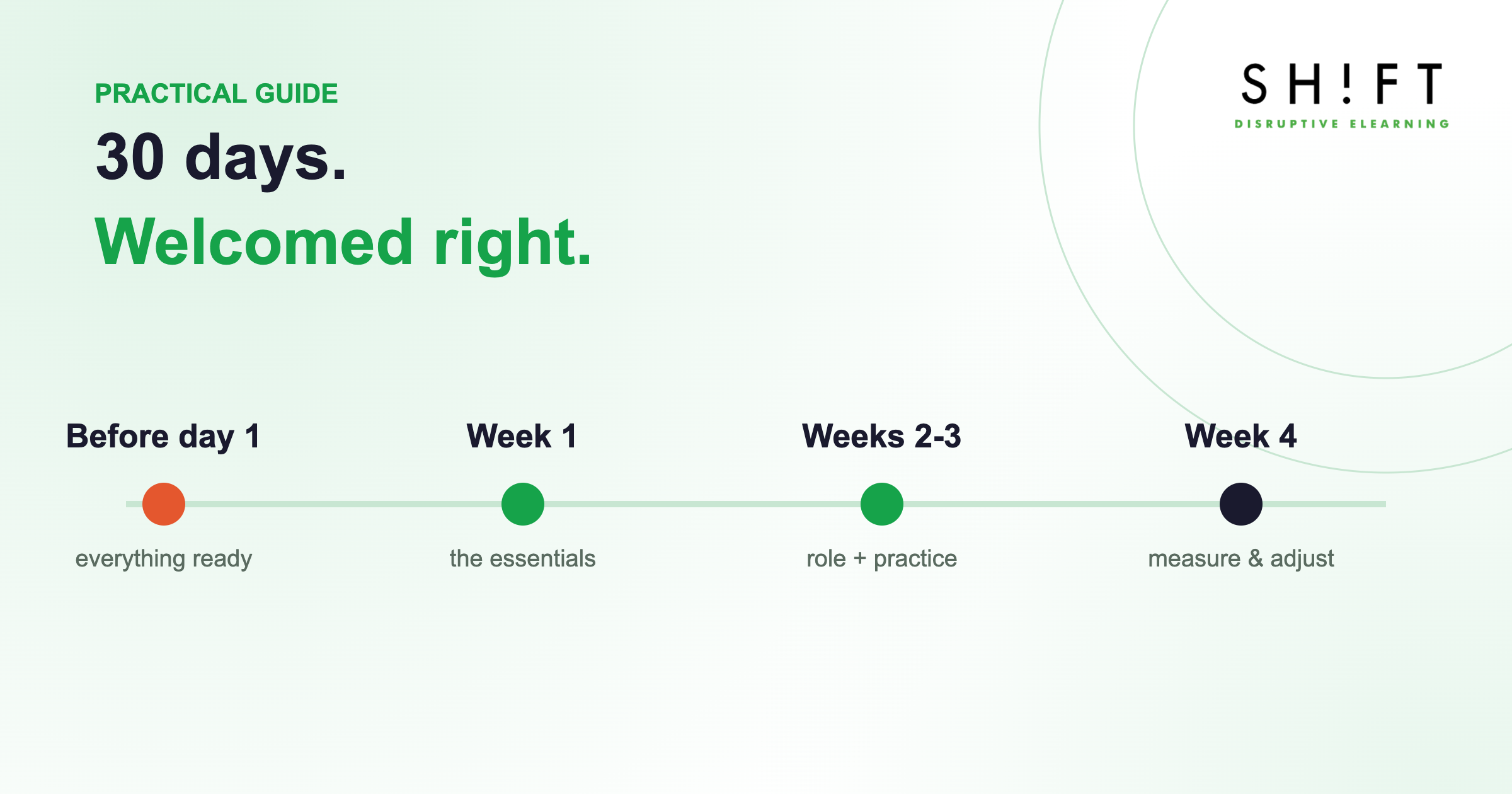
Four stages. Each with one clear mission.
Before day 1: everything ready
The worst first day starts with "hold on, we're creating your access." The welcome is prepared before the person arrives.
- Their platform access already works.
- Their learning path is already assigned, based on their role.
- They received a welcome message: what to expect in week one.
- Their manager already has the first conversation scheduled.
Week 1: the essentials, not everything
The classic mistake: dumping all the company's information on someone in five days. Nobody can absorb that.
The right question is: what does this person need to start working with confidence? That — and only that — goes in week 1.
Weeks 2 and 3: their role, with practice
They know the company now. Time to master the job.
This is where practice makes the difference. If the person will sell, let them practice sales conversations with simulations — before facing a real customer. If they'll handle difficult cases, let them rehearse first. Failing in practice is free; failing live is expensive.
Week 4: measure and adjust
Did the onboarding work? Don't guess. Look at three signals:
1. Path progress. Did they complete the lessons? If many new hires get stuck at the same point, the problem is the point — not the people.
2. First real task. Have they done real work, at reasonable quality? That's the goal of the month.
3. How they feel. One honest conversation at the end of the month: what helped most? What was too much? What was missing?
And here's the best part: use what you learn from every new hire to adjust the path. Fix the confusing lesson. Add what was missing. Since creating and editing is fast now, your onboarding improves with every single hire. In six months you'll have an onboarding no competitor can improvise.
What to automate, and what to keep human
Simple rule: automate the logistics, never the relationship.
Automate: enrollments, role-based paths, reminders, certificates, progress reports.
Keep human: the manager's welcome, the buddy, the check-ins, celebrating the first win.
When the machine carries the logistics, people have time for the human part. That balance is what makes onboarding feel warm — and run like clockwork.
Onboarding on autopilot (except the human part)
SHIFT's LMS assigns role-based paths, sends reminders, and shows you each new hire's progress — automatically. Creating eLearning since 1996, with 6+ million people trained across 43+ countries.
Meet the SHIFT LMSReady to transform your corporate training?
See real results from companies that train with SHIFT — or talk to our team.