


SHIFT's eLearning Blog

Our blog provides the best practices, tips, and inspiration for corporate training, instructional design, eLearning and mLearning.

To visit the Spanish blog, click here
    All Posts

    6 reasons why you should use games in your eLearning courses

    These days many companies talk about training while playing working, so maybe you are wondering why? As it turns out, games help reinforce training in the workplace. Therefore, we consider you should know at least six reasons why you should start using games in your eLearning courses.
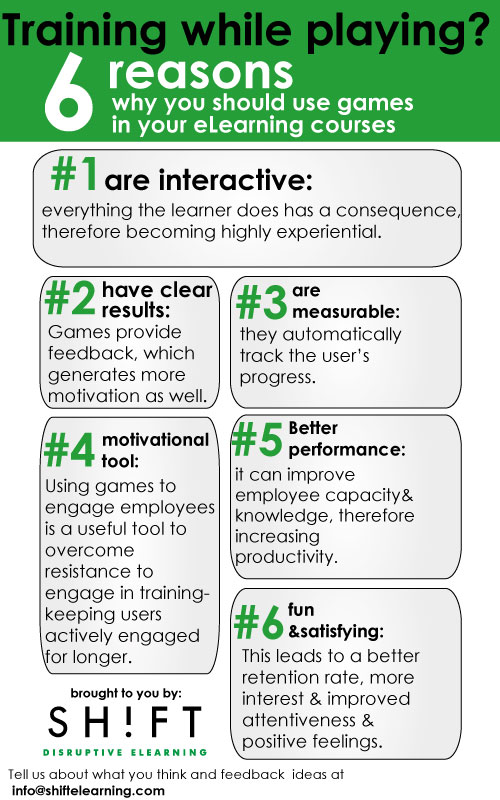

    games in elearning

    Karla Gutierrez
    Karla Gutierrez
    Karla is an Inbound Marketer @Aura Interactiva, the developers of SHIFT. ES:Karla is an Inbound Marketer @Aura Interactiva, the developers of SHIFT.

    Related Posts

    The Smarter Training Roadmap for 2026

    If January has taught us anything, it’s that the "Content Factory" era is officially behind us. Throughout this month, we’ve explored a single, driving truth: In 2026, the measure of L&D success isn't how much we build, but how well we support business execution. We started the year by asking a hard question: Is your training busy, or is it effective? We looked at why organizations are stripping away the complexity of EdTech to focus on what matters, ecosystems that reduce development time and personalized journeys that actually stick. We also introduced the concept of Microlearning 3.0, powered by AI tools like SHIFT Meteora, which moves beyond simple "short content" to deliver AI-driven performance support directly in the flow of work. As we wrap up our focus on Smarter Training for Better Business Results, let’s distill these insights into a final roadmap. Here is how you can ensure your team doesn't just "do" training this year but drives the kind of data-driven results the C-Suite celebrates.

    Ultra-Short Tip: How to Turn Training into Results (Without Creating More Courses)

    In previous articles, we saw that training no longer competes for "more content," but for better execution. The next step is moving from "delivering learning" to "activating performance" at the exact moments where the business wins or loses. In 2026, the problem isn’t a lack of training. The problem is that, even with training, execution remains inconsistent: everyone solves problems "their own way," errors are repeated, and results depend on who handles the case. Smart training shifts the focus: it doesn't design to cover topics; it designs to standardize critical decisions that drive business KPIs.

    Smart Training in 2026: Learning That Impacts Results

    In 2026, training stops being measured by completed courses and starts being measured by execution. Organizations achieving real impact don’t train by topic: they design learning around the critical moments where decisions are made, errors happen, and business results are defined. The Real Problem L&D Faces Today In this new stage of L&D, the conversation no longer revolves around “what course is missing,” but around a much more relevant question for the business: