

Take a look at your surroundings for a moment and observe the different tasks performed…
- Have you stopped and analyzed the different activities involved in the production process?
- Have you identified which of these can be called “best practices”?
This article will be very useful if you’ve never had those doubts before or if solving them has become a priority in your company.
Characterize your eLearning production processes
A process is defined as a series of joint tasks performed in order to accomplish a specific product. In the case of eLearning we can state that the production process is made up of a series of activities used to develop a learning strategy or a specific course.
According to the type of organization or characteristics it may have, there are several methods you can follow when determining this process. On one end we have absolute experimentation, where people have complete freedom to carry out tasks as they please because parameters have not been set, but on the other hand we have a process that’s completely defined, where activities are structured and must be performed according to predefined standards.
In between both extremes there’s a case where some actions are already defined but not to a point of complete specificity.
There is always the possibility of formalizing or characterizing the process when needed, regardless of how it was established in the first place.
What does characterizing a process mean?
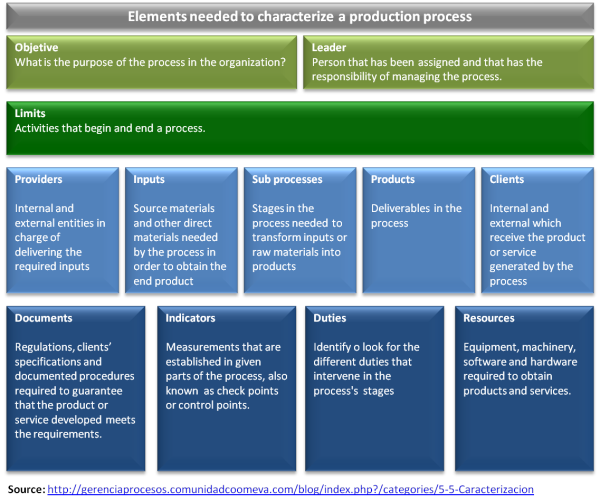
We refer to characterizing as identifying and defining all factors that get involved in a process and that should be controlled.
Of course we can state a great deal of elements or activities that have to be characterized in order to obtain an eLearning product, but there are three fundamental variables that should be considered when defining a production process:
- Content development: It’s the main element when developing an eLearning course; therefore its characteristics will be directly related to the end results obtained.
- Project management: Efficiency in project management can lead to the fulfillment of goals and the organization of risks that may come in your way.
- Quality assurance: Looking out for quality and following standards in the process will be reflected in the quality of the end results obtained.
How can we know if a process is completely defined?
When we’re able to state all steps and activities needed to execute a process and those activities can be measured in a simple and objective manner, we’re able to state that the process has been completely defined.
Once we’re sure that the process has been completely characterized, you will need to implement it. Even though this is the last phase, it’s essential to the process’s success, due to the fact that there can be some sort of resistance towards change which can be controlled appropriately when detected on time.
Just like all other areas of technology, when it comes to eLearning it has to be as flexible as possible in order to adapt itself to the needs of an ever changing market and industry but at the same time it has to be well defined in order to ensure a predictable result that meets all predefined goals.