


When it comes to eLearning, quality definitely matters. eLearning professionals are not only tasked with creating useful, relevant and meaningul content, but they are also responsible for addressing learner motivation and making sure the learning experience has a lasting impact.
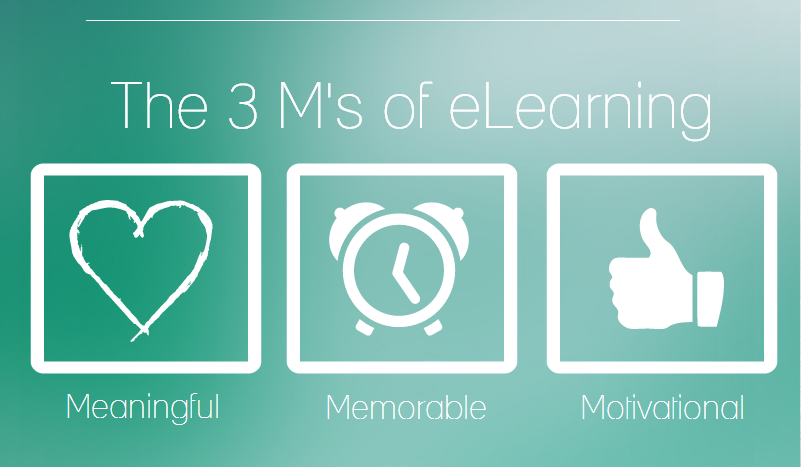
Develop an eLearning course by using the 3 M’s taught by Michael W. Allen and increase your chances of success. Make your eLearning courses M1) meaningful, M2) memorable, and M3) motivational. If you fail to achieve one of them, your program won't produce the impact you desire. You need all 3… not only 1!
1) Meaningful
The first M to include in your eLearning courses is meaning. Meaningful eLearning modules do much more than present information to learners to consume. Instead, they actively engage the learner in meaning making. As Michael W.Allen says: "Good learning experiences aren't just about facts, they are about becoming a more proficient, capable, and valuable person."
One of the most common mistakes in eLearning course design is assuming. Course designers forget that what is common knowledge to them may be unknown territory for learners. This is a good way to make sure the learner is lost before he or she begins. For eLearning success, designers needs to take a step back and change focus. The courses should to be targeted specifically to their intended audience. There is no point in creating an eLearning course if the content doesn't make sense to them. Learners immediately need to see the relevance of the material and appreciate the benefit they gain from it. Look at the material from the student’s point of view to make it have the greatest impact.
2) Memorable
The next M of eLearning is memorability. If you want to succeed in eLearning, you have to create a lasting impression with your delivery of content. You have to engage emotions and make learning experiences compelling and remarkable.
A learning experience that no one remembers is just wasted time and effort. Traditional learning materials are full of text that many learners have trouble retaining. Digital learning experiences overcome this by being interactive and dynamic. Moreover, you can produce promising and impactful effects through imagery, games, surprise, practice or other forms to help learners retain what they've learned. Make DOING part of the learning experience with elements that demand the students to practice the things they are learning. It's much easier to remember actions than simple observations. This kind of learning brings the student into the process and helps the learner internalize and retain the new information more effectively.
Include interactivity to have learners active. But, have learners do more than just pushing the Next button or clicking on a graphic. Make them think. After a lesson point, engage the learner in scenarios that require them to apply their new knowledge. Incorrect answers could open a help or review element that reinforces the assimilation of the material. Combine see, hear and do for unique striking impressions. The more impactful and impressive your course is, the chance of learners remembering your content increases.
3) Motivational
The final M of the puzzle is motivation. While you can’t make a person learn, you can create an environment that is more contributive to learning. You do this by crushing demotivational factors. Encouraging positive emotions, such as realization, fullfillment and satisfaction will make learners want to invest more mental effort to a specific learning activity. Therefore, every course designer's goal should be to inspire students to understand and retain important information. If learners are motivated, they will want to learn more.
Develop eLearning courses that arouse curiosity, engage, and captivate attention before introducing detailed information. Build tangible rewards into the course so that learners have an incentive to engage with the material. Introduce content using stories or drama or even include elements of risk in the assessments.
Effective eLearning motivates people to apply what they learn to real world situations. If you fail to do this, the learning experience is wasted. Target specific points and actively encourage learners to apply new knowledge and skills because they see a tangible reward for doing so.
Keep the 3 M's in Mind Always!
eLearning has the potential to create a new, dynamic and engaging learning environment, far beyond the boring, passive eLearning models. Combine these three M's in your eLearning modules and learners of every type will get more from your lessons.