


eLearning and social media are not so different at all. Attention, after all, is the currency of social media—Facebook especially.
As an eLearning professional, there is much to be learned from how people engage on social media. Below are some social media lessons you can apply on your next project.
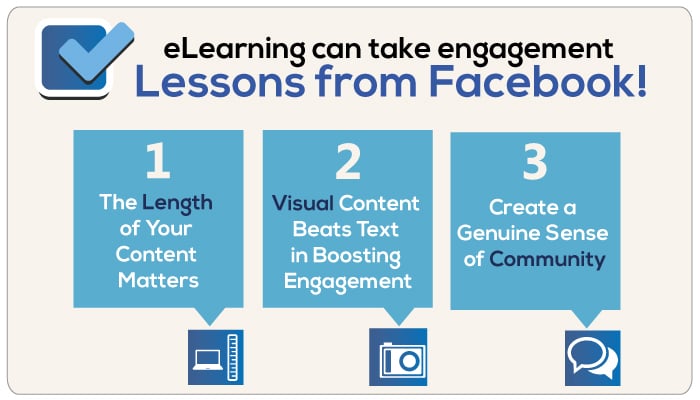
1) The Length of Your Content Matters
A Facebook study revealed that posts between 100 and 250 characters gained 60 percent more likes, comments and shares. Online marketing company Constant Contact confirmed this when it published posts with less than 140 characters and gained about 215 percent more engagement.
While there’s no hard and fast rule on how long Facebook posts should be, most companies reported better engagement with posts shorter than 140 characters. And it’s easy to understand why.
Online users on Facebook and other social platforms have limited attention span. The fast-moving nature of their overflowing news feed also explains why short, shareable and appealing content wins.
What does this mean for eLearning? All of these findings point out what’s obvious: short and simple messages are much more effective. It demands you to create bite-sized learning, which is backed by science.
Our limited working memory can easily process and retain“bite-sized” information; longer chunks are unmanageable. By thoughtfully breaking down content into bite-sized chunks or sections, learners are able to understand and absorb a concept or subject quickly. More importantly, they do not have to go through irrelevant information and waste their precious time.
Chunking, of course, isn’t everything. For this technique to work, your content has to be meaningful, memorable and motivational. It has to appeal to the individual learner’s goals.
2) Visual Content Beats Text in Boosting Engagement
The stats really says it all:
On Facebook, videos are shared 12 times more than text and link posts combined; photos are liked more two times more than text posts.
On Tumblr, a whopping 62 percent of posts are photos.
Youtube has 100 million users actively watching videos every week. Videos and photos on Pinterest refer more traffic than posts from Twitter, LinkedIn, Google+ and StumbleUpon.
We don’t just consume visual content; visual content drives engagement in the world wide web. It’s a launching point for casual conversations, even heated debates and lengthy discussions.
Visual content can help you create engaging eLearning material too.
Learners get easily attracted to visual content. A photo or video carefully chosen never fails to capture a learner’s interest. It invites him or her to spend more time learning. What’s more, visual content usually makes it easier for learners to focus. They tell a story, their colors delight the eyes, and they require little or no effort from users.
Be sure to use great images—those that support your learners’ goals. When effectively chosen, images and videos can help students recall or retain information by as much as 65 percent. Other studies also confirmed that 40% of people will respond better to visual information than plain text.
Also, don’t overwhelm your audience with having too many visual elements. Strike a thoughtful balance between images and texts. And be creative in choosing a visual format. Most eLearning material contains lots of photographs, especially stock photography. Try a short video clip, an infographics or a simple animation.
There are many other ways to incorporate visual content into your material. But here’s the only rule you shouldn’t break: don’t use a visual element just for the sake of using one. Use it, instead, to support your goals and your learners’.
3) Create a Genuine Sense of Community
No high-tech trick can help you create a vibrant, active community online. That’s because actual participation in social media is fueled by community-focused motivations . Think of giving and receiving help, of creating lasting relationships, and of interacting socially with those who share your point of view. All of these confirm our roles as social beings—even before the rise of the Internet and social media.
As an eLearning professional, you play an important role in building a community of enthusiastic learners. The Internet opens up a wide range of opportunities for genuine engagement. Use that technology wisely to help students make the most out of their social environment. Students have much to learn from each other and its part of your noble profession to make that happen.
And another thing: make sure you talk like yourself. Be transparent if you want others to trust you. People on Facebook can sense it if the other’s faking interest. They know too when someone genuinely cares about them. So open up and reach out, not just as a teacher but as a human being.
Cammy Bean, a respected name in the eLearning industry, encourages us professionals to ask ourselves before publishing: would your learner’s thank you for this?
It’s a great question to ask yourself. It confirms that an eLearning material is effective if and only if it helps learners.