


SHIFT's eLearning Blog

Our blog provides the best practices, tips, and inspiration for corporate training, instructional design, eLearning and mLearning.

To visit the Spanish blog, click here
    All Posts

    SHIFT's New Feature: Scenarios and Avatars for Any Mobile Device

    2014 started off right, full of motivation and effort clearly focused on meeting our commitment to quality and innovation in every action we take.

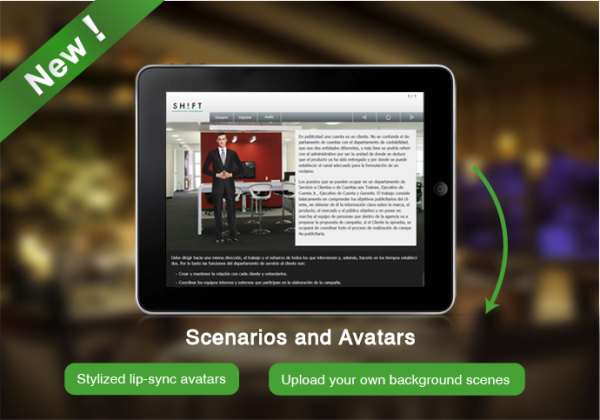
    Today, we present SHIFT’s new ability to create Scenarios and Avatars for HTML5.
    New Scenarios and Avatars NEWSLETTER con fondo 01 resized 600

    This development, allows users to recreate multiple scenes in just seconds.

    Incredibly easy to use, this feature consists of an interface that offers a perfect combination: stylized, human-like, lip-synched avatars along with background scenes you can upload, and if required, add text or audio too.

    Scenarios and Avatars peque v2 para blogspot

    With just one click the tool allows users to include avatars in their mobile learning courses. No programming needed. Moreover, SHIFT’s new set of avatars are more human-like than ever in order to create realism and generate the emotional response of a true human interaction.  

    And that's not all! If needed, you can customize the various avatars available and load them into your course.

    All of these resources in one place ... a superb integrated and efficient development that allows users to enjoy a multimedia experience on any device.

    Imagine being able to build your own scene: choose where to place the avatar or the text within the screen, modify colors or even use the interface without any of these items.

    Create personalized screens very easily and surprise your learners with truly innovative training products.

    We invite you to explore SHIFT’s new Scenarios and Avatars family.

    Related Posts

    Ultra-Short Tip: How to Turn Training into Results (Without Creating More Courses)

    In previous articles, we saw that training no longer competes for "more content," but for better execution. The next step is moving from "delivering learning" to "activating performance" at the exact moments where the business wins or loses. In 2026, the problem isn’t a lack of training. The problem is that, even with training, execution remains inconsistent: everyone solves problems "their own way," errors are repeated, and results depend on who handles the case. Smart training shifts the focus: it doesn't design to cover topics; it designs to standardize critical decisions that drive business KPIs.

    Smart Training in 2026: Learning That Impacts Results

    In 2026, training stops being measured by completed courses and starts being measured by execution. Organizations achieving real impact don’t train by topic: they design learning around the critical moments where decisions are made, errors happen, and business results are defined. The Real Problem L&D Faces Today In this new stage of L&D, the conversation no longer revolves around “what course is missing,” but around a much more relevant question for the business:

    Smarter Training for Better Business Outcomes

    In 2026, organizations are rethinking a key question: How should training support real work and business results? For some companies, this means optimizing what they already have. For others, it means taking the first step toward digital training. But the starting point is the same: the focus is no longer on producing more courses or expanding catalogs, but on training smarter. We are talking about learning experiences designed to be relevant, timely, and directly aligned with business objectives, not academic agendas or vanity metrics. When Instructional Design expertise is combined with AI-driven technologies, training teams can boost performance, improve decision-making, and generate insights that actually matter to the organization—without adding unnecessary complexity or losing the human side of L&D.