Our blog provides the best practices, tips, and inspiration for corporate training, instructional design, eLearning and mLearning.
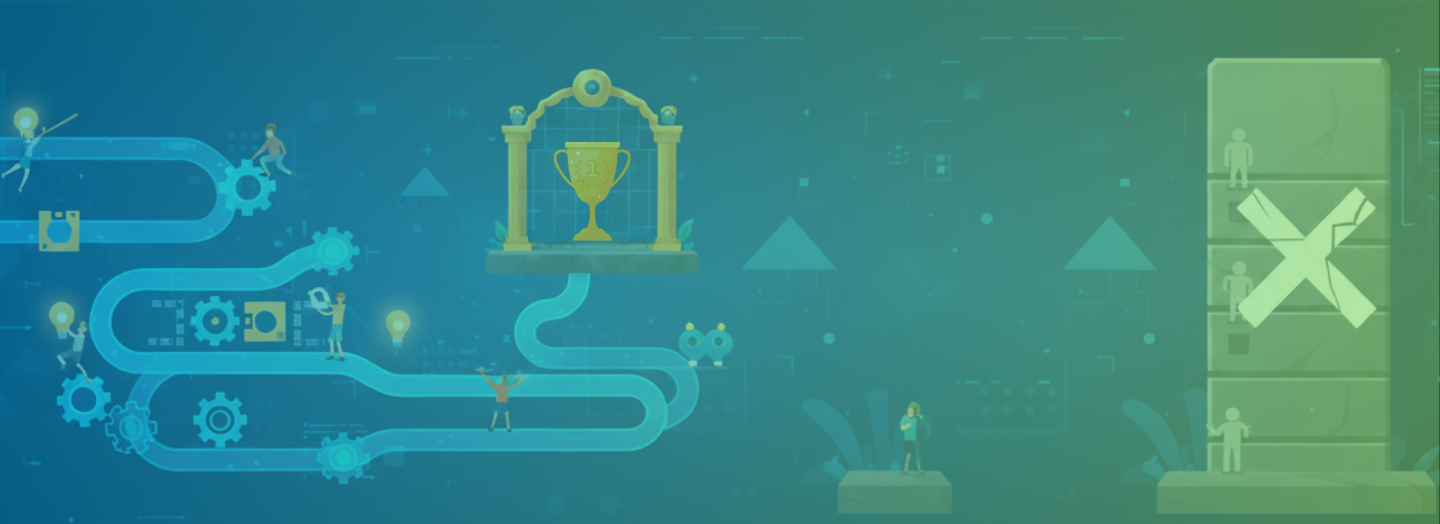
To visit the Spanish blog, click hereLet’s rip the band-aid off: Leaderboards are the "participation trophies" of corporate training. Sure, they work for the top 5% of your hyper-competitive salespeople. But for the other 95% of your workforce? A leaderboard isn't motivating. It’s a public reminder that they are "losing." Once an employee realizes they can’t crack the Top 10, they check out. Game over. If you want to create a true addiction to learning, the kind that keeps gamers glued to screens for hours, you don’t need a scoreboard. You need Flow. Video games are addictive because they adapt to the player. Level 1 is easy. Level 50 is brutal. If the game stayed at "Level 1" difficulty forever, you’d get bored and quit. If it started at "Level 50," you’d get frustrated and quit. This is where traditional eLearning fails, and where adaptive learning software changes the game entirely.
We all know the feeling: You open an app "just for a second," and suddenly 20 minutes have passed. You were engaged, focused, and maybe even enjoying yourself. Now, imagine if your employees felt that way about your corporate gamification strategy. For too long, L&D has treated gamification as a visual layer, slapping a leaderboard on a PDF and calling it a day. But true gamification isn’t about points; it’s about psychology. It’s about creating a "Learning Loop" that feels natural, rewarding, and yes, habit-forming. To move beyond superficial badges, we need to look at the engine behind the world’s most engaging apps: Nir Eyal’s Hook Model. Here is how you can use this 4-step framework to build a gamification strategy that drives real performance.
Let’s be honest: Your top sales executive doesn’t care about a digital "Gold Star" for finishing a compliance video. They don’t want a "Subject Matter Ninja" badge for clicking Next fifty times. If your corporate gamification strategy relies entirely on leaderboards and stickers, you aren't gamifying learning—you’re patronizing your workforce. For years, the L&D industry has confused "gamification" with "decoration." We took boring, static slides and plastered points on top of them, expecting engagement numbers to skyrocket. Instead, we got employees who click through content just to make the notifications stop. To fix engagement, we must stop designing for children and start designing for the adult brain.
If January has taught us anything, it’s that the "Content Factory" era is officially behind us. Throughout this month, we’ve explored a single, driving truth: In 2026, the measure of L&D success isn't how much we build, but how well we support business execution. We started the year by asking a hard question: Is your training busy, or is it effective? We looked at why organizations are stripping away the complexity of EdTech to focus on what matters, ecosystems that reduce development time and personalized journeys that actually stick. We also introduced the concept of Microlearning 3.0, powered by AI tools like SHIFT Meteora, which moves beyond simple "short content" to deliver AI-driven performance support directly in the flow of work. As we wrap up our focus on Smarter Training for Better Business Results, let’s distill these insights into a final roadmap. Here is how you can ensure your team doesn't just "do" training this year but drives the kind of data-driven results the C-Suite celebrates.
Over the past month, we’ve explored a transformation that organizations can no longer afford to ignore: AI-powered learning embedded directly into the flow of daily work. One conclusion stands out clearly:corporate learning can no longer exist only in isolated “training moments.” Operations don’t pause for learning. Decisions pile up. Pressure builds. And the gap between knowing and doing shows up exactly where it matters most—during critical tasks, exceptions, complex conversations, and processes that demand consistency. This final article closes the month by addressing the essential question: What does it really take for AI-powered learning to work inside the flow of work—and stay sustainable over time?
AI-powered learning enables development to happen within operations, not outside of them In most organizations, work doesn’t stop so people can “go learn.” Decisions, processes, and interactions happen in real time. And it is precisely there, right in the middle of execution, where learning can create its greatest impact. Integrating artificial intelligence into daily workflows is no longer a future promise; it is a tangible competitive advantage. Today, AI-powered solutions make it possible to improve efficiency, quality, decision-making, and customer experience without interrupting operations. It’s no coincidence that 87% of companies adopting AI report direct improvements in productivity and time savings. The question is no longer whether AI can be integrated into the flow of work. The real question is how to do it effectively and measurably.
SHIFT has been awarded Gold in the 2025 Brandon Hall Group Excellence in Technology Awards™, in the category Best Advance in AI for Business Impact, for its AI authoring platform, SHIFT Meteora.
In a workplace where the pace of change outstrips the capacity of traditional training, organizations face a growing challenge: How can they ensure their teams acquire and apply skills exactly when the business needs them? A new approach is emerging—one that is completely redefining corporate learning: AI-driven learning integrated directly into daily workflows. This model eliminates the long-standing gap between “learning” and “doing.” Training stops being an isolated event and becomes continuous support that accompanies people as they carry out their real tasks.
We combine best-in class technology, strategy and future-proof business solutions to bring your content to life, faster!