Our blog provides the best practices, tips, and inspiration for corporate training, instructional design, eLearning and mLearning.
To visit the Spanish blog, click hereWhether you are a training manager, learning & talent development consultant or an eLearning designer, it is now time to take a fresh look at your audience. They have changed! The Millennials are everywhere, and they make up the lion's share of your audience.
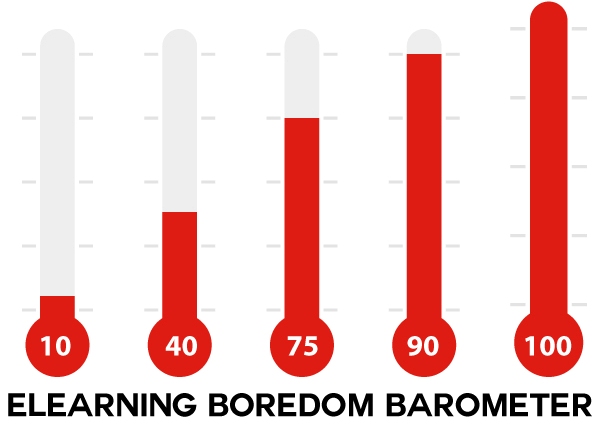
How do you liven up a dull room? You hang a painting or go in for a fresh paint job. How do you wear a staid-looking dress and not look like a plain Jane? You accessorize it with a colorful scarf, a designer clutch, or a pair of killer heels. How do you revamp your old eLearning courses so that your learners are not bored to death? You can follow the tips below.
When it comes to eLearning, every course will be unique. Hence, the purpose of your efforts needs to be defined before you begin to plan and develop the course required to meet that end. This is done by creating an overall strategy for the eLearning project.
As eLearning professionals we want to take our students on a learning adventure where they come out on the other side brimming with knowledge, inspiration and staggering awe for their superhero-like trainer. Ok, maybe these goals might be a tad unrealistic. Even the best eLearning designers can sometimes drop the ball when it comes to training because we forget that what comes easily to us might not come easily to our students and maybe, just maybe we might even overestimate our students’ abilities and interest level. In order to effectively train, we have to evaluate how we present information and make it easily accessible to both novice and expert learners. The trick is though; we can’t dumb down information to the point that it sounds condescending. Remember, at one point there was a time even you didn’t understand the techniques you are now training, keeping that in mind will help direct your training style.
Why do you think film makers employ scriptwriters to write dialogs? Why can't anybody write an ad copy? Why do writers spend hours polishing the language of their texts? Why do our political leaders and heads of nations depend on speechwriters to write what they want to say to their followers? That's because words matter! Words are powerful tools that can stir emotions and rouse crowds to action. A cheery "hello" breaks the ice. A heartfelt "how are you" is the start of many lasting relationships. A sincere "sorry" mends broken hearts. And think of all the great political speeches delivered throughout the centuries. Those words have led entire nations to war and ushered in social revolutions. Words are so powerful that they can change the way the brain perceives to make us act and feel.
Remember those days in school when you used to cram in whole books the night before the test? Did you remember afterwards even a wee bit of what you gobbled up within the space of a few hours? You didn't because you had to cram in the same chapters again when the next test was around. On the other hand, you still remember the multiplication tables that you learned years ago. Why do you think you forgot what you learned the night before the test and remember what you learned years ago? It couldn't be that you didn't work hard to learn. No it isn't. The answer is in the way you learned. Crammed or typical learning (learning in a hurry and all at once) does not aid retention. But when learning is both spaced out and repeated, you remember more. As an instructional designer, it is imperative that you know the difference between the two learning methods, so you can design courses that stick.
For freelance eLearning professionals and training consultants, building and nurturing relations with clients is integral to the success, growth, and sustainability of their business. Poor communication is a surefire way to damage any project or relationship. Regular/prompt, detailed, and personalized communication. That’s the secret to keeping clients happy and your eLearning projects on track. This post will highlight the important tips for keeping healthy communication with your clients, without losing your sanity.
There's you. Then there are the graphic designers, the coding guys, and the client. How do you ensure that you are all on the same page about the eLearning course that you are developing so painstakingly? How do you ensure that at the end of the developmental stage, your client does not come back perplexed with these words, "But I thought you were going to…?" These ominous words usually trigger a flurry of activity back at the drawing board. Efforts increase, costs escalate, and tempers are frayed (usually at the client's end). How do you ensure that all stakeholders get a fair idea of how the eLearning course will turn out to be right at the outset, so you are spared the re-work? Do Rapid Prototyping. Here's everything you need to know about it.
We combine best-in class technology, strategy and future-proof business solutions to bring your content to life, faster!